Marketing Debt Is Already Charging Interest

The old service is still on the website.
Three versions of the logo live in three different folders. Nobody remembers which one is current.
The email list contains customers, prospects, former volunteers, vendors, and people no one can identify. The monthly report arrives, but it does not answer a question anyone is making a decision about.
The team keeps meaning to fix these things.
Instead, another campaign begins.
This is how marketing debt accumulates: one reasonable delay, workaround, or unresolved decision at a time.
Like technical debt, marketing debt is not simply unfinished work. It is unfinished work that makes future work harder. Every new campaign inherits the unclear positioning. Every new employee must decode the file system. Every new landing page copies language no one has reviewed. Every report adds data without improving understanding.
The interest appears as friction.
Projects take longer. Approvals multiply. Inconsistencies spread. Opportunities are missed. Trust becomes more expensive to earn because the organization must first explain which version of itself is accurate.
Small teams cannot eliminate every backlog. They can stop treating all neglected work as harmless.
A backlog waits. Debt compounds.
There will always be more worthwhile marketing work than time to complete it. A future idea, an untested channel, or a page you may someday build is not automatically debt.
Work becomes debt when postponing it creates a recurring cost, risk, or constraint.
An outdated brochure becomes debt when staff must correct it during every conversation. An undocumented email process becomes debt when only one person can send the newsletter. An unclear value proposition becomes debt when every campaign requires a new debate about what the organization actually offers.
A useful test is simple:
If leaving this unresolved makes the next piece of work slower, less accurate, harder to measure, or more likely to fail, it is probably marketing debt.
The original delay may have been sensible. A small business needed to serve customers. A nonprofit had a deadline. A team used the tools and information available at the time.
Debt is not evidence of laziness. It is evidence that a temporary choice has outlived the conditions that made it useful.
The five forms of marketing debt
Marketing debt rarely lives in one platform. It moves across strategy, content, channels, data, and operations.
1. Message debt
Message debt appears when the organization has changed but the language has not caught up.
Common symptoms include:
The homepage emphasizes an offer that is no longer central
Sales conversations rely on explanations that do not appear anywhere else
Employees describe the organization in fundamentally different ways
Different channels promise different outcomes
Important qualifications or evidence are missing from claims
Message debt spreads quickly because language is copied. One vague service description becomes a presentation, an email sequence, a LinkedIn profile, a proposal, and a dozen social posts.
The Federal Trade Commission states that advertising claims must be truthful, not deceptive or unfair, and supported by evidence. That makes message maintenance more than a matter of style. Claims that have drifted beyond what the organization can substantiate create risk as well as confusion.
2. Content debt
Content debt is the accumulation of material that is outdated, duplicated, orphaned, or no longer useful.
It includes forgotten web pages, old PDFs, expired program information, broken links, abandoned blog categories, and articles written for an audience the organization no longer serves.
Outdated content does not become harmless because it is difficult to find in the navigation. Search engines, saved links, old emails, and external references may continue to send people to it.
The UK Government Digital Service treats content maintenance as an operating responsibility. Its guidance recommends review dates and distinguishes between updating, withdrawing, and unpublishing material that is no longer current. The underlying lesson applies to smaller organizations: publishing creates an obligation to revisit.
Google also recommends creating helpful, reliable, people-first content rather than producing material primarily to attract search traffic. More pages are not automatically a stronger content program. A smaller collection of accurate, useful material can create more value than a large archive no one owns.
3. Channel debt
Channel debt develops when the organization continues using a platform without a current reason, owner, or operating standard.
The neglected profile still appears in search. The social account publishes only when someone remembers. The newsletter has no defined audience. The business listing shows old hours. A campaign directs people to an inbox no one monitors.
Google’s Business Profile guidance asks organizations to represent themselves accurately and consistently, including their names, service areas, categories, and other information. That sounds basic. It is also exactly the kind of work that gets deferred while teams chase more visible campaigns.
A channel creates debt when its existence creates expectations the organization does not reliably meet.
4. Experience debt
Experience debt is the gap between what the marketing promises and what people encounter when they try to act.
Examples include:
A compelling campaign leading to a confusing page
Forms that are difficult to use on a phone
Important information embedded in inaccessible images or PDFs
Slow pages, unstable layouts, or broken links
Calls to action that lead nowhere useful
Contact processes with no confirmation or follow-up
The World Wide Web Consortium’s accessibility guidance organizes WCAG around 4 principles: content should be perceivable, operable, understandable, and robust. Google’s Core Web Vitals similarly focus on real user experience through loading performance, responsiveness, and visual stability.
The broader point is not that every small organization must pursue technical perfection. It is that a campaign cannot outperform the experience waiting at the other end of the click.
5. Operating debt
Operating debt lives behind the work.
It includes undocumented processes, unclear ownership, scattered files, inconsistent naming, missing approval rules, manual repetition, inaccessible account credentials, and reporting no one trusts.
This debt is easy to overlook because the audience may never see it directly. They experience its consequences: slower responses, irregular publishing, preventable errors, and a brand that changes depending on who created the asset.
Operating debt also makes automation dangerous. Automating an unstable process does not create a system. It allows confusion to travel faster.
Before automating, the team needs to know:
What triggers the work
Which inputs are authoritative
Who owns each decision
What quality means
Which exceptions require judgment
Who approves the final output
If those answers do not exist, the immediate need is not another tool. It is an operating decision.
Why the interest keeps rising
Marketing debt compounds through reuse.
Teams rarely start every project from zero. They duplicate the last campaign, copy the current web page, reuse the old audience list, or adapt a report someone built months ago.
That is efficient when the source is sound. It is expensive when the source contains unresolved problems.
Old ambiguity becomes new work
When positioning is unclear, every writer, designer, salesperson, and partner must interpret it again. The organization keeps paying for the same strategic decision without ever making it.
Workarounds become infrastructure
A temporary spreadsheet becomes the customer database. A personal account becomes the only administrator. An improvised folder becomes the asset library.
The longer the workaround survives, the more work depends on it and the harder it becomes to replace.
Measurement loses context
Reports accumulate metrics while campaign names, conversion definitions, tracking methods, and business priorities change.
Eventually the organization has more data and less confidence. The problem is not the absence of numbers. It is the absence of a stable question those numbers are meant to answer.
Inconsistency weakens trust
One mismatch may be minor. A pattern is different.
When the website, business listing, proposal, social profile, and employee explanation all disagree, people must decide which version to believe. Some will ask. Others will leave.
Do not begin with a total overhaul
Once a team sees the debt, the temptation is to declare a cleanup project and stop everything else.
That usually fails. The scope becomes too large, current work still needs attention, and the cleanup loses momentum.
A better approach is to prioritize debt according to the consequence of leaving it in place.
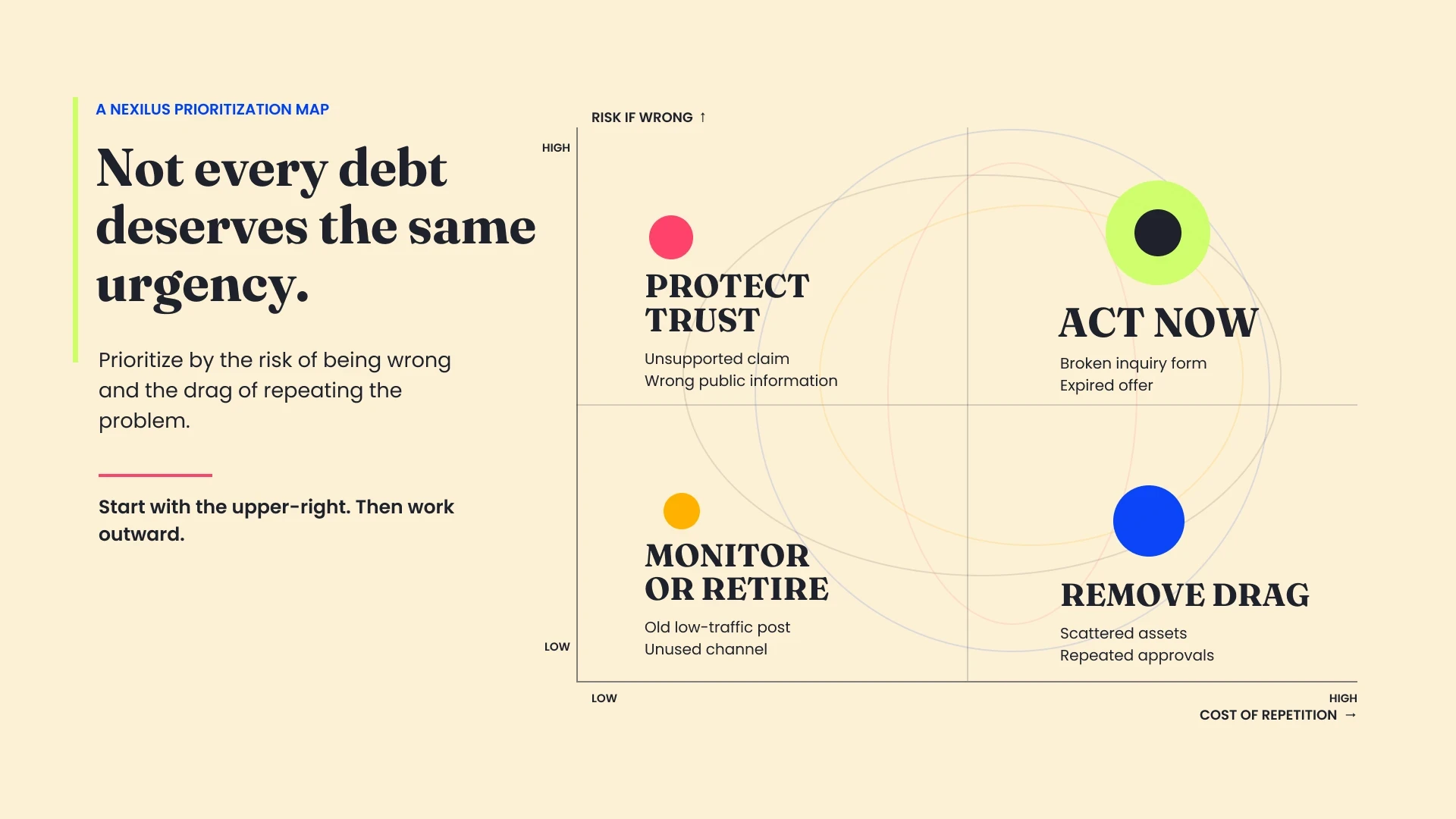
First: protect trust and accuracy
Correct anything that could materially mislead, disappoint, exclude, or endanger the audience.
That may include:
Incorrect contact information, hours, eligibility rules, or pricing
Unsupported or outdated claims
Broken high-traffic forms and conversion paths
Accessibility barriers in essential content
Expired offers or programs that still appear available
Public accounts no responsible person can access
This is not cosmetic maintenance. It is risk reduction.
Second: repair the path to action
Review the journey from interest to the next meaningful step.
Can people understand the offer? Can they tell whether it fits them? Can they take action without searching for instructions? Does someone receive and respond to the result?
Fix the points that interrupt that journey before investing in more traffic.
Third: remove repeated internal friction
Look for the problems the team corrects every week.
Create one approved message source. Establish one asset library. Document the publishing sequence. Assign channel owners. Define the small set of measures that inform real decisions.
The best debt payment often eliminates a recurring conversation.
Fourth: make maintenance visible
Every important marketing asset should have an owner and a reason to be reviewed.
That does not require a complex governance platform. A simple register can include:
Asset or system | Owner | Risk if outdated | Next review | Decision |
|---|---|---|---|---|
Homepage offer | Name or role | High | Date | Keep, revise, or retire |
Business listing | Name or role | High | Date | Verify |
Email welcome sequence | Name or role | Medium | Date | Test and update |
Brand asset library | Name or role | Medium | Date | Consolidate |
Monthly report | Name or role | Medium | Date | Tie to decisions |
The register matters because invisible maintenance is easy to postpone.
Fifth: automate only after the process becomes trustworthy
Automation works best when it repeats an intentional system.
Once the team has defined the source, owner, rules, review standard, and approval boundary, automation can reduce the cost of recurring work. It can prompt reviews, prepare drafts, resize approved assets, assemble reports, and flag missing fields.
It should not decide which version of the organization is true.
A 90-minute marketing-debt audit
You do not need to inventory everything before making progress.
Bring together the people who own marketing, sales, service, operations, fundraising, or customer communication. Then work through 4 questions.
1. What do we repeatedly apologize for?
Capture every version of “ignore that page,” “the deck is old,” “only one person knows how,” and “we still need to fix that.”
Repeated caveats are debt signals.
2. Where do people receive conflicting information?
Compare the website, search listings, social profiles, email sequences, proposals, presentations, directories, and frontline explanations.
Do not debate wording yet. Identify the conflicts.
3. Which unresolved issue slows the most future work?
Choose the decision with the largest downstream effect.
Clarifying the core offer may improve the website, proposal, sales script, content plan, and advertising at once. Fixing one isolated post will not.
4. What can we repair, assign, or retire in the next 30 days?
Select a small number of actions with clear owners.
Some debt is paid by improving an asset. Some is paid by documenting a process. Some is paid by deciding that a channel, page, report, or campaign no longer deserves maintenance.
Retirement is a legitimate strategy.
The goal is not a clean slate
Marketing will never be finished.
Organizations change. Audiences change. Platforms change. A system that is healthy today will still require attention later.
The goal is not to eliminate every imperfection. It is to prevent neglected decisions from controlling what the organization can do next.
That means treating maintenance as part of marketing, not as the work that happens after marketing. It means creating fewer assets with clearer ownership. It means repairing the source instead of correcting every copy. It means refusing to automate confusion.
Most marketing debt does not announce itself as a crisis.
It appears as the extra hour, the repeated explanation, the missed follow-up, the report no one uses, and the campaign that cannot quite overcome the system behind it.
The interest is already being paid.
The question is whether the organization will keep paying it or finally reduce the principal.
What is your marketing debt costing you?
NEXILUS helps small businesses and nonprofit organizations identify the strategic, content, experience, and operating gaps that make marketing harder than it should be, then build practical systems that can move forward.


